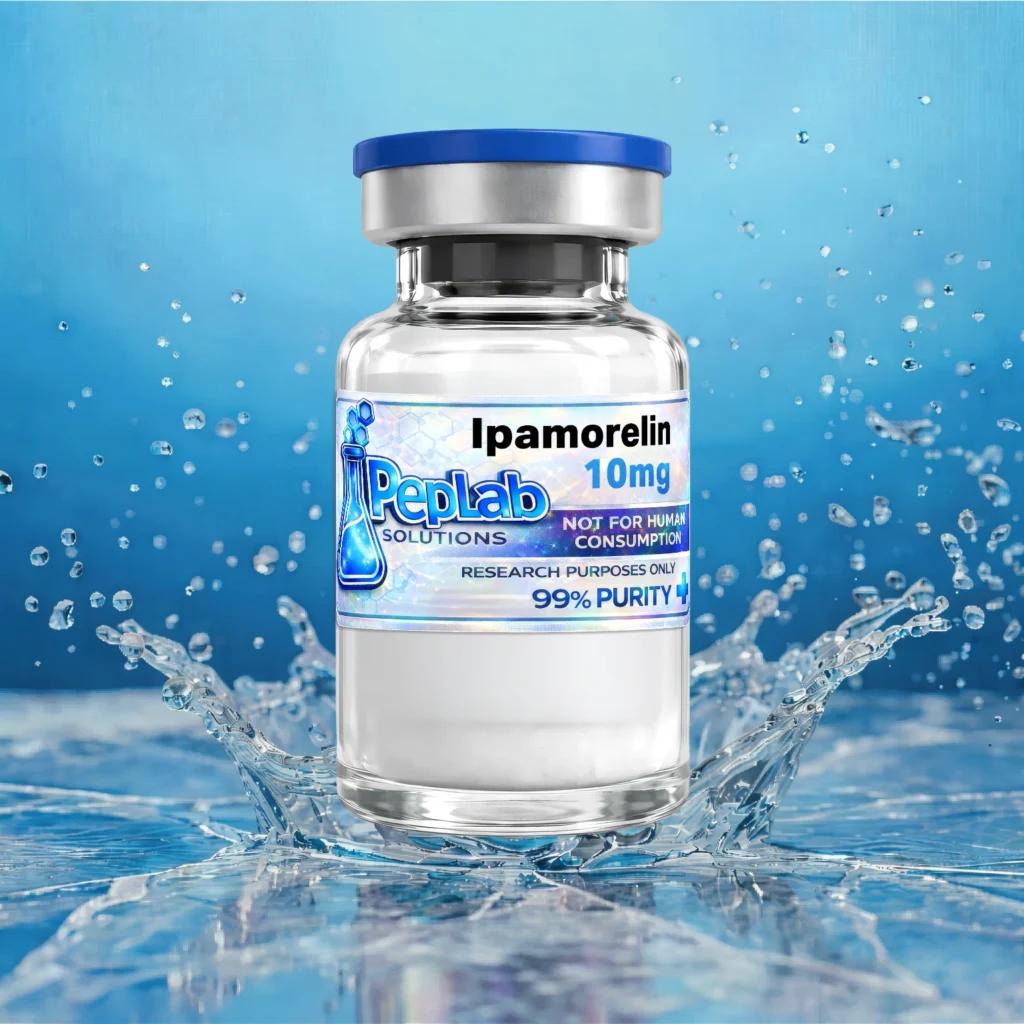
IPAMORELIN
Price range: $95.00 through $160.00
Contents: Ipamorelin 5mg and 10mg
Form: Lyophilized powder
Purity: >99%
FREE Shipping on $200+ orders
Ipamorelin and Glucocorticoid-Related Muscle & Bone Loss
Research suggests that Ipamorelin may help reduce the catabolic effects caused by glucocorticoids (GC) on muscle strength and bone development. In one study involving adult female rats treated with methylprednisolone, animals receiving both GC and Ipamorelin showed improved muscle performance and significantly higher periosteal bone formation compared to rats given GC alone. The results indicated stronger calf muscle contraction and nearly fourfold greater bone formation activity. These findings suggest that Ipamorelin may help preserve skeletal muscle and support bone health during glucocorticoid exposure.
Ipamorelin and Bone Mineral Support
Additional studies evaluating Ipamorelin and GHRP-6 in female rats reported increases in body weight as well as tibial and vertebral bone mineral content (BMC). Researchers observed that the improvement in bone formation appeared linked to larger bone dimensions and increased cortical bone area rather than changes in bone density itself. While cortical bone mineral density (BMD) remained relatively stable, the findings suggest that growth hormone secretagogues such as Ipamorelin may contribute to stronger skeletal structure and enhanced bone growth potential.
Ipamorelin and Muscle Preservation
Glucocorticoids are known to promote muscle wasting and negative nitrogen balance. Research involving Ipamorelin suggests the peptide may help counter these catabolic effects. In laboratory studies, Ipamorelin reduced nitrogen loss, lowered hepatic urea synthesis activity, and improved nitrogen retention in animals treated with prednisolone. Although growth hormone (GH) produced stronger effects overall, Ipamorelin still demonstrated measurable improvements in nitrogen balance and organ nitrogen content. These findings indicate potential value in supporting muscle preservation and reducing tissue breakdown during steroid-related treatment.
Ipamorelin and Insulin Secretion Research
Studies have also explored the relationship between Ipamorelin and insulin release. Research using pancreatic tissue from both normal and diabetic rats found that Ipamorelin stimulated insulin secretion at multiple concentrations. Scientists observed that certain receptor-blocking agents could reduce this insulin response, suggesting involvement of calcium channels and adrenergic pathways. These findings have generated interest in Ipamorelin’s possible relevance in diabetes-related metabolic research, particularly concerning glucose regulation and pancreatic function.
Ipamorelin and Postoperative Ileus (POI)
Postoperative ileus (POI), a condition involving delayed gastrointestinal recovery after surgery, has also been investigated in relation to Ipamorelin. Clinical studies evaluating intravenous Ipamorelin in abdominal surgery patients reported a reduction in the time needed to tolerate the first meal after surgery when compared with placebo groups. Although the findings were not statistically significant, the research highlighted the peptide’s possible role in supporting gastrointestinal recovery and motility after surgical procedures.
Ipamorelin as a Ghrelin Receptor Research Tool
The ghrelin receptor is known to be overexpressed in several medical conditions, including certain cancers and heart-related disorders. Because Ipamorelin binds strongly to ghrelin receptors, researchers are investigating its use in receptor imaging and diagnostic studies. Current research involving PET imaging probes derived from growth hormone secretagogues suggests that compounds like Ipamorelin may help scientists better understand ghrelin receptor activity and its role in disease progression and metabolic regulation.
| Units | 5mg, 10mg |
|---|
Be the first to review “IPAMORELIN”
Related products
PEPTIDES
PEPTIDES
PEPTIDES
PEPTIDES
PEPTIDES
PEPTIDES
PEPTIDES
PEPTIDES
Reviews
There are no reviews yet.